
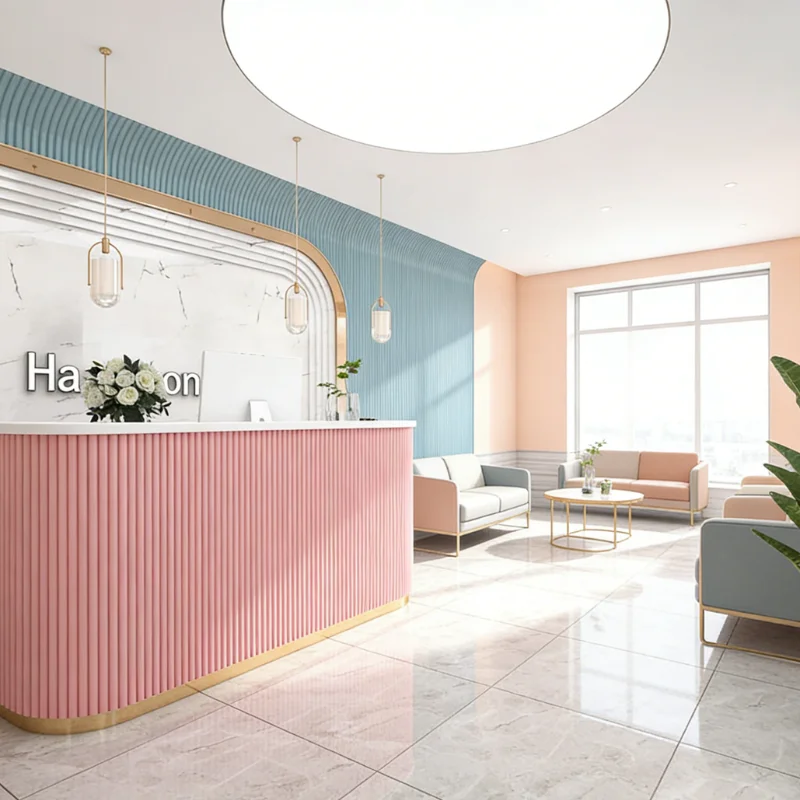
What the Right Reception Desk Size Should Actually Do
The right desk size reduces friction in daily operations. It allows check-in, payment, and booking tasks to run in parallel instead of competing for space.
A properly sized desk keeps movement clear between the entrance, reception, and waiting area. When sizing is incorrect, delays appear quickly, especially during peak hours.
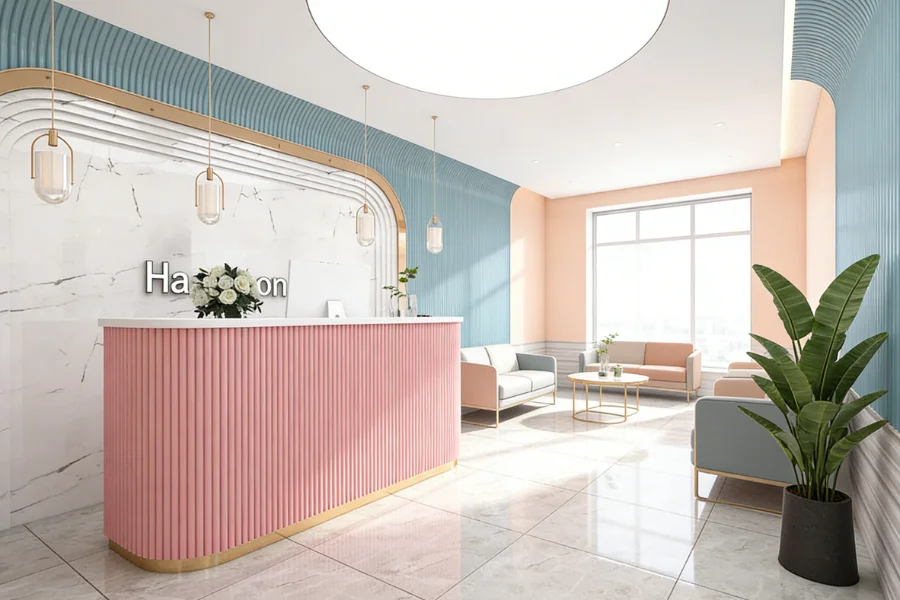
Reception Desk Size Guide – Length, Depth, and Height Explained
Height – Set for Natural Interaction
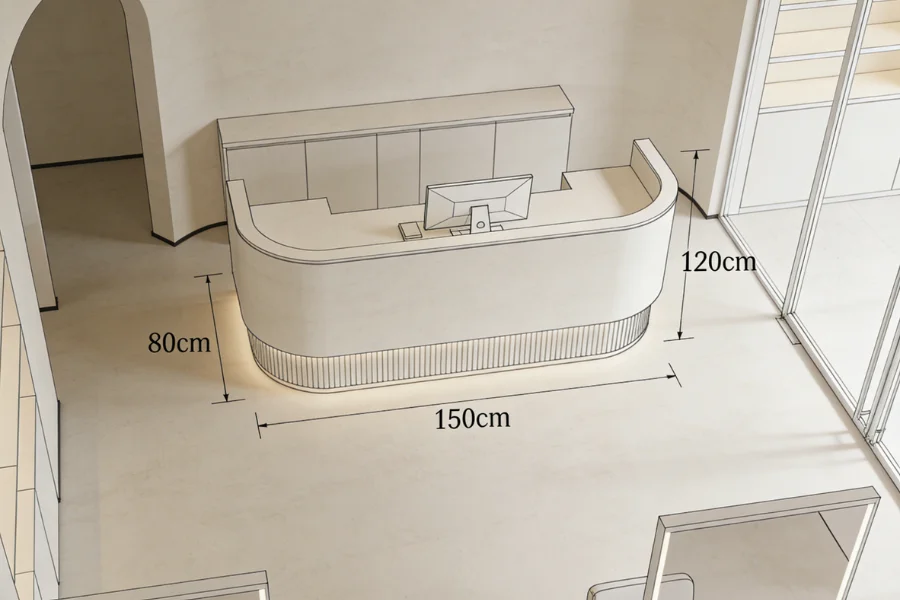
The recommended height is 110–120 cm. This range supports comfortable communication between standing clients and staff, while allowing receptionists to alternate between standing and seated work.
If the desk is too low, it weakens the visual structure of the space. If it is too high, it creates a barrier that slows interaction.
Width – Determined by Staff and Task Load
Desk width should reflect how many people use it at the same time. A single receptionist typically needs 80–120 cm, while two staff require 120–180 cm. Larger salons often need 180 cm or more.
Each receptionist needs approximately 70–90 cm of working width to handle tasks without overlap. When width is insufficient, tasks must be handled one at a time, reducing efficiency.
Depth – Controls Reach and Work Efficiency
The recommended depth is 60–75 cm. This range allows space for POS systems, booking tools, and daily tasks while keeping everything within reach.
Depth beyond 90 cm reduces efficiency, as staff must lean forward repeatedly. Most equipment requires around 45–50 cm, leaving the remaining space for active use.
How Desk Size Impacts Your Salon’s Daily Workflow
Reception is the first operational point where delays can occur. Desk size directly affects both client movement and staff performance.
Client Movement
Clients typically follow a fixed path from entrance to reception, then to the waiting area. Oversized desks disrupt this path and create bottlenecks, while undersized desks cause crowding during check-in.
In busy periods, a narrow desk often prevents a clear queue from forming, leading to confusion at the entrance.
Staff Movement
Staff need uninterrupted access to tools, storage, and payment systems. When space is limited, items overlap and movement becomes repetitive.
A properly sized desk allows each task zone to remain stable, reducing unnecessary repositioning and improving speed.
Peak Hour Scenario
During peak hours, multiple interactions happen at once. One client may be paying, another checking in, and another asking questions.
If the desk is under 120 cm, one interaction must pause. A wider desk allows tasks to run simultaneously, improving service flow.
How to Choose Desk Size Based on Your Salon Layout
Desk size should match both available space and staff requirements.
| Salon Size | Recommended Width | Depth | Desk Type | Key Focus |
|---|---|---|---|---|
| Small (<45 m²) | 80–120 cm | 60–75 cm | Straight | Space control |
| Medium (45–140 m²) | 120–180 cm | 60–90 cm | Straight or L-shape | Multi-tasking |
| Large (>140 m²) | 180 cm+ | 75–90 cm | L-shape, U-shape, custom | Traffic handling |
For most layouts, start with staff needs, then adjust based on circulation space and client volume.
How Much Space You Really Need Around a Reception Desk
Desk dimensions only work when surrounding space is planned correctly.
Use these minimum guidelines:
- Front clearance of at least 120 cm for client access
- Staff workspace depth of at least 80 cm behind the desk
- Queue space of at least 150 cm in front of the desk
- Distance of at least 100 cm between reception and waiting area
These measurements ensure smooth movement, even during high traffic periods. In full layout planning, suppliers like NovaBeauty are often involved early to align reception sizing with overall space design.
Reception Desk Types – Which Size and Shape Works Best
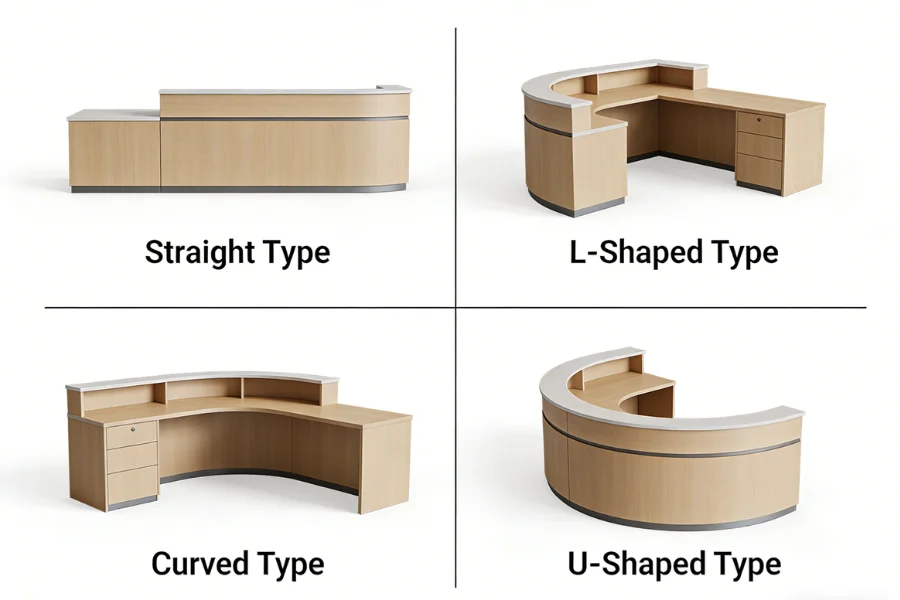
Straight Desk – Best for Controlled Spaces
Straight desks typically range from 120–240 cm in width with a depth of 60–90 cm. They are suitable for smaller layouts where space needs to remain predictable and efficient.
L-Shaped Desk – Best for Task Separation
L-shaped desks range from 150–300 cm combined. They allow different tasks such as booking, payment, and product handling to occur in separate zones.
This reduces task overlap and improves efficiency in multi-staff environments.
Curved Desk – Best for Continuous Flow
Curved desks range from 150–240 cm in width. Their shape reduces directional changes, allowing clients to approach naturally without stopping or adjusting position.
This supports smoother movement in open layouts.
U-Shaped Desk – Best for High-Volume Operations
U-shaped desks typically start at 180 cm and above. They create defined work zones and allow multiple staff to operate without interference.
They are best suited for large salons with continuous client flow.
Reception Desk Size Mistakes That Hurt Workflow
Desk That Is Too Large
An oversized desk blocks circulation paths and reduces usable space. It can also make cleaning and maintenance more difficult.
The solution is to size the desk based on actual movement patterns rather than visual preference.
Desk That Is Too Small
A desk that is too small leads to cluttered surfaces and limited workspace. Equipment overlaps and tasks slow down during busy periods.
The solution is to allocate enough width per staff member and include built-in storage.
Ignoring Equipment Requirements
Failing to account for equipment results in insufficient workspace. Staff are forced to rearrange items throughout the day.
Listing all tools and systems in advance helps ensure proper sizing.
What Features Your Reception Desk Actually Needs
Ergonomics and Comfort
Desk height should align with natural arm positioning. Adequate legroom is necessary for seated work, and anti-fatigue mats help reduce strain during long shifts.
Comfort supports consistent staff performance.
Storage and Organization
Reception desks should include lockable drawers, shelves, and cable management systems. These features reduce clutter and improve task efficiency.
A structured workspace also improves the overall perception of professionalism.
Material and Durability
Material selection should match operational demands. Laminate works well in high-use environments, while solid wood supports long-term structural stability.
Surfaces must resist staining from salon products and allow easy cleaning.
Branding Integration
Branding elements such as logos, color matching, and integrated lighting should support the space without interfering with usability.
Effective branding enhances recognition while maintaining functional clarity.
How to Improve Your Reception Area Beyond Desk Size
Reception performance depends on more than the desk itself. The surrounding environment also affects efficiency and experience.
Consider seating that does not block movement, product displays that integrate with the desk, and a clear visual backdrop behind reception.
Coordinating reception desks with styling chairs, shampoo units, and storage systems through suppliers like NovaBeauty helps maintain consistency across the entire layout.
Final Thoughts – Plan Your Desk for Workflow, Not Just Looks
A reception desk is part of your operational system, not just a visual element.
The right size supports parallel task handling, reduces unnecessary movement, and improves client flow. The wrong size creates repeated delays that affect the entire service process.
Start with layout and workflow, then choose dimensions that support both.