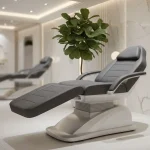
It is 9:40 on a Tuesday, and your 10 o’clock client booked a facial with a leg massage add-on. You need the bed flat for the massage, raised for the extractions, and tilted slightly so drainage runs the right way. With a two-motor bed you do two of those three by hand — and the client feels every clunk.
That is usually the moment a spa owner starts shopping for a 4 motor beauty bed. But four motors are not automatically better. On a bed that only ever does flat facials, the extra actuators are money you could have spent on a better stool, better lighting, or a second treatment room. Here is how to tell which motor count your service menu actually needs.
What Each Motor Moves
Electric beauty beds are built around linear actuators, and each one controls a single movement. The first two are almost always the same:
- Motor 1 — height. Raises and lowers the whole platform, usually from about 22 inches to 34 inches. This is the one your back cares about most, because it lets you work seated instead of hunched.
- Motor 2 — backrest. Reclines the upper section from flat to roughly 70–80 degrees. Essential for facials, lash work, and anything where the client needs to sit up.
- Motor 3 — legrest. Lifts the knee section independently. This is what separates a facial bed from a treatment bed: leg massage, pedicure prep, and prenatal positioning all depend on it.
- Motor 4 — tilt or a fourth section. On most four-motor beds this is a full-platform tilt (head down or feet down), though a few designs use it for a independently adjustable foot section or a sliding seat. Ask which one you are buying, because the two behave very differently in the room.
2, 3, or 4 Motors: Side by Side
| Configuration | What moves | Best fit | Typical factory-direct price |
|---|---|---|---|
| 2 motors | Height + backrest | Basic facial and waxing rooms, mobile estheticians, tight budgets | $600–$1,000 |
| 3 motors | Height + backrest + legrest | Full-service facial rooms, lash studios, day spas doing massage add-ons | $850–$1,500 |
| 4 motors | Height + backrest + legrest + tilt or fourth section | Med spas, lymphatic and prenatal work, multi-service treatment rooms, four-hand massage | $1,200–$2,400 |
Those ranges are for wholesale or factory-direct purchases in 2026, before freight. Retail showroom pricing in the US typically runs 40–80% higher for the same factory build, which is the main reason independent spa owners buy direct and wait out the ocean freight.
When the Fourth Motor Pays for Itself
Three service types make a tilting platform worth the money:
Lymphatic drainage and post-surgical massage. A 10–15 degree head-down tilt lets fluid drain toward the lymph nodes without stacking pillows under the client’s hips. Pillow stacking is slower, and it changes the angle of the cervical spine — clients feel it in the neck the next day.
Prenatal treatments. From the second trimester, lying flat is uncomfortable and sometimes unsafe. A slight incline plus a raised leg section takes pressure off the vena cava, and a tilt function lets you fine-tune the angle instead of propping the client up with rolled towels.
Four-hand massage and couples work. Two therapists need room to work on both sides of the body at once. A four-motor bed with independent leg and back sections can be set lower and flatter than a three-motor bed without losing access to the client’s feet.
If none of those describe your menu, the fourth motor is a nice-to-have. If two or more do, it is the difference between booking the service and turning it away.
When Three Motors Is the Smarter Buy
Most US spas do 70–80% facials, and a facial only needs height and backrest. The legrest earns its keep the moment you add a neck-and-shoulder massage, a hand treatment, or lash work that runs long. That is why three motors is the volume seller for day spas and lash studios — it covers the realistic menu without paying for a tilt function that gets used twice a month.
Spend the difference on what clients actually touch: denser foam (4–6 lb density holds up better than 2 lb), a removable face cradle with a memory foam pad, and a stool that matches the bed’s height range. A $1,100 three-motor bed with good upholstery beats a $1,900 four-motor bed with a thin mattress.
Specs That Matter More Than Motor Count
Motor count is easy to market and easy to fake. These are the numbers worth checking on the spec sheet:
- Weight capacity. Look for 300kg (about 660 lb) on the frame, not the mattress. A bed rated at 150kg will sag in the middle within a year of daily use.
- Certification. Electric beds sold into the US should carry CE certification and a documented compliance file. Ask for the certificate number, not just the word on the listing.
- Voltage. 110V-240V dual voltage means the same bed works in a US treatment room and a Canadian or European one without a transformer. It also makes resale easier.
- Controls. A hand remote plus a foot pedal is the practical combination — your hands are busy and often wet. Check that the remote has a lockout so a client cannot play with the buttons mid-service.
- Manual release. Every electric bed should have a way to lower the platform if the power drops. Ask how it works before you buy, not after.
- Warranty and parts. One year on the frame and electrics is the realistic baseline at this price point. Confirm that actuators and remotes are stocked as spare parts, because a $90 actuator failure should not sideline a $2,000 bed for six weeks.
Freight and Lead Time
Factory-direct beds ship from China in 10–15 days after order confirmation, then 4–6 weeks door-to-door to most US addresses with DDP shipping — duties and delivery included, no customs broker on your side. Ordering a single sample is normal; MOQ 1 is common with direct manufacturers, which is how most independent spas test a supplier before outfitting three rooms.
Measure the path before the truck arrives: a 4-motor bed with a tilt mechanism is heavier and often wider at the base than the two-motor version you saw online. Doorways, stair turns, and elevator depth are the three places deliveries fail.
Quick Answers
Is a 4 motor beauty bed worth it for a small spa?
Only if you sell lymphatic, prenatal, or four-hand services. Otherwise put the money into a three-motor bed with better foam and a second set of sheets.
What does a 4-motor bed weigh?
Most sit between 70kg and 95kg depending on base and mattress. Check the freight class, and measure the delivery route — a second-floor walk-up with a narrow landing is a real constraint.
If you are still deciding between drive types, our comparison of hydraulic and electric beauty beds covers lift speed and service costs. Once you have a bed picked out, the motor and remote troubleshooting guide explains the failures you can fix yourself. Browse the full electric beauty bed range to compare motor configurations and base finishes side by side.