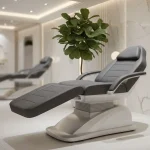
An esthetician in Portland bought two 32-inch-wide treatment beds for a two-room suite because wider sounded more luxurious. They were beautiful. They were also the reason her hallway became a one-way corridor: with 30-inch doorways and a 44-inch hall, a 32-inch bed plus a rolling stool left about eight inches to walk through.
Width is the specification clients never notice and operators feel every single day. Here is how to choose it without measuring twice and regretting once.
The Standard Beauty Bed Widths
Most treatment beds sold for US spas and salons fall into four widths, measured across the upholstered top at the widest point.
- 28 inches: compact beds for lash, brow, and small treatment rooms. Narrow enough for tight layouts, but clients cannot rest their arms comfortably at their sides.
- 30 inches: the working standard for facials, waxing, and massage. Wide enough for most adults to lie with arms down, still fits through a standard 32-inch door.
- 32 inches: the comfort upgrade. Noticeably better for larger clients, prenatal work, and longer massage sessions.
- 34 inches and up: bariatric or dual-purpose beds. Check the door, the hall, and the room clearance before ordering.
Does Width Change Client Comfort?
Yes, in a specific way. The average adult shoulder width is roughly 16 to 18 inches, so a 28-inch bed gives most clients about five inches of margin on each side — enough to lie flat, not enough to let the arms relax outward. On a 30-inch bed, that margin grows to six or seven inches per side, which is where most people stop feeling like they might roll off.
For prenatal massage, the difference is bigger. Side-lying positions need pillow volume and a wider base, and a 32-inch bed keeps the client from perching near the edge. For lash work, where the client lies still for 90 minutes, width matters less than the face cradle and headrest angle.
Width vs Room Fit: The Numbers That Matter
This is where most purchases go wrong. A bed that fits the room on paper can still fail in daily use.
Plan 24 to 30 inches of clear walkway on the working side of the bed, and at least 18 inches on the client’s entry side. Add the stool: a tech seated at the bed occupies another 20 to 24 inches. If the room is 10 by 10 feet, a 30-inch bed centered with 30-inch walkways works. A 32-inch bed in the same room leaves 29 inches — still workable, but tighter every time someone carries a towel cart through.
Doorways are the hard limit. A 30-inch bed on a frame with casters needs a 32-inch door opening at minimum, and the caster base is usually wider than the upholstered top. Measure the widest point of the base, not the mattress. If the only path is a 30-inch door with a jamb, a 28-inch bed is the honest answer.
Length, Height and Width Work Together
Width gets the attention, but length and height decide whether the bed is usable. Standard treatment beds run 73 to 75 inches long; anyone over 6-foot-2 will notice the difference. Height matters for your back, not the client’s: 24 to 32 inches at the top of the cushion suits most seated work, and an electric lift covers that range without a stool.
On an electric bed, check that the frame does not splay outward when raised. Some low-cost designs gain stability by widening the base as the bed lifts, which eats the clearance you just measured.
Weight Capacity and Frame Build
Ask for the rated capacity in writing. Nova treatment beds are rated to 300 kg across the frame and lift, which covers bariatric clients with margin. A bed rated at half that will still hold an average client — until the motor strains on the third lift of the day and the frame starts to creak.
Look at three things on the spec sheet: the steel gauge of the frame, the number of motors, and whether the lift column is centered. A centered column with a wide base is more stable at full height than twin narrow columns mounted near the edges.
Width Options at a Glance
| Width | Best for | Room requirement | Typical US price |
|---|---|---|---|
| 28 in | Lash, brow, tight rooms, upper-floor suites | Fits 30 in doors; 9×9 ft room comfortable | $700 – $1,100 |
| 30 in | Facials, waxing, standard massage | 32 in door; 10×10 ft room | $900 – $1,500 |
| 32 in | Prenatal, larger clients, longer sessions | 34 in door; 10×12 ft room | $1,200 – $2,000 |
| 34 in + | Bariatric and dual-purpose rooms | 36 in door; 11×12 ft room | $1,500 – $2,400 |
Prices reflect market ranges for electric beds with a basic remote. Hydraulic and fixed-height beds sit at the lower end; four-motor beds with a face cradle cutout sit higher.
Sheets, Pads and Bolsters
Width changes your linen order. A 30-inch bed takes a fitted sheet sized for 30-inch tables; a 32-inch bed needs the next size up, or the corners pop every time the client rolls. Standard flat sheets handle both, but budget for the extra fabric. If you use a memory foam topper, add its thickness to the cushion height when you calculate sheet fit.
Bolsters and positioning wedges are sized by bed width too. A 32-inch wedge on a 28-inch bed overhangs the edge and eventually tears at the seam.
Ordering from Nova
Nova builds treatment beds factory-direct with wholesale pricing, MOQ 1, and sample orders available for testing before a full rollout. Motors are CE certified and wired for 110V-240V dual voltage, so the same bed works in a US build-out or an overseas location. Production takes 10 to 15 days, then DDP door-to-door shipping to the USA runs about 4 to 6 weeks by sea. Every bed carries a one-year warranty.
Specify width, length, and lift height on the order. These are frame-level choices, not upholstery swaps — changing width after production starts means starting over.
If you are still working out the room, our guide to beauty bed room clearance walks through walkway and door measurements in detail. For the structural side, see weight capacity and frame build. Current models are listed on the beauty bed category page.
FAQ
Is a 30-inch beauty bed wide enough for massage?
For most clients, yes. A 30-inch bed gives six to seven inches of margin per side at shoulder height. Move to 32 inches if you handle prenatal work or larger clients regularly.
Will a 32-inch beauty bed fit through a standard door?
Usually not without removing the door. A 32-inch top typically sits on a wider base, so measure the caster frame and allow at least two inches of clearance.
Does bed width affect the motor or weight capacity?
Not directly. Capacity comes from the frame and lift design. A wider bed spreads load over a larger base, which can improve stability at full height.