
Why Vietnamese-Owned Nail Salons Are So Common in the U.S.
Vietnamese Americans didn’t just enter the nail industry — they built a model that made it scalable, accessible, and repeatable.
Today, they represent roughly half of nail technicians across the United States, with even higher concentrations in states like California. This level of presence reflects a structured approach to service delivery, staffing, and pricing rather than isolated success.
For salon owners, this is a working model. It shows how a service business can expand quickly without relying on large upfront investment or complex branding.

How the Nail Industry Connection Started in 1975
The starting point traces back to 1975, when Vietnamese refugees arrived in the United States after the Vietnam War.
During this time, actress Tippi Hedren helped introduce manicure training to a group of 20 Vietnamese women in a California refugee camp. The skill was practical, quick to learn, and immediately usable for income generation.
This was not a large-scale initiative. It worked because it created a repeatable entry point into the workforce, which could be passed from one person to another without formal infrastructure.

Why Nail Services Were Easier to Start Than Other Businesses
Nail services offered one of the most accessible entry points in the beauty industry, especially for new immigrants.
The advantages were operational, not theoretical:
- Short training time
Basic services can be learned in a matter of weeks, allowing workers to start generating income quickly. - Low startup cost
Many businesses begin with a single rented station, reducing financial risk during the early stage. - Lower language requirements
Service delivery depends more on technique than conversation, which lowers communication barriers.
In practice, this means new operators can test the business model with minimal risk, then expand once demand becomes predictable.
How Vietnamese Salons Expanded Through Family and Training
Growth did not rely on traditional hiring. It relied on internal training and trust-based networks.
Early technicians trained family members and friends, sharing both technical skills and daily operating methods. This reduced onboarding time and avoided the delays often seen in external recruitment.
In real salon operations, this model creates three advantages:
- Faster team expansion without long hiring cycles
- More consistent service standards across staff
- Lower training costs over time
This is why many Vietnamese-owned salons were able to scale across cities while maintaining stable service delivery.
How Lower Prices Turned Nail Services Into Everyday Spending
Before the 1980s, nail services were positioned as a premium offering. Vietnamese salon owners changed this by adjusting both pricing and workflow.
Instead of maximizing revenue per client, they focused on total daily output:
- Affordable base pricing
Lower prices made services accessible to a wider customer base - Higher daily volume
More appointments per day replaced reliance on high individual spending - Standardized services
Clear service structures reduced decision time and improved speed
In day-to-day operations, this often results in shorter service cycles and more repeat visits. Many salon owners observe that consistent, mid-priced services generate more stable revenue than occasional high-ticket bookings.
This approach shows that demand grows faster when services become routine rather than exclusive.
What Salon Owners Can Apply From This Business Model
The Vietnamese American nail salon model offers practical lessons that can be applied directly.
Choose services that scale easily
Select services that can be taught quickly and repeated consistently. This reduces training time and allows faster expansion.
Prioritize efficiency over decoration
A functional layout improves movement flow and reduces delays between services. During peak hours, poor layout decisions can increase service time per client by 10–20 percent.
Build your own training pipeline
Training staff internally creates consistency and reduces dependence on external hiring, which is often slower and less predictable.
Use pricing to increase frequency
Pricing should encourage repeat visits rather than maximize one-time transactions. Higher visit frequency often leads to more stable monthly revenue.
Each of these decisions directly affects daily performance, not just long-term strategy.
Common Mistakes When Copying This Salon Model
Many salon owners attempt to follow this model but miss the structure behind it.
Lowering prices without controlling costs
Affordable pricing only works when supported by efficient workflow and optimized labor allocation.
Ignoring workflow design
When manicure and pedicure zones overlap or intersect, staff movement slows down, especially during busy hours.
Investing too early in decor
Decor does not increase service capacity. Without efficient operations, visual upgrades provide limited return.
Relying only on external hiring
Without internal training systems, maintaining consistent service quality becomes difficult as the team grows.
Avoiding these mistakes helps maintain balance between cost, speed, and service quality.
How to Set Up a Nail Salon for Better Workflow and Efficiency
The physical setup of a salon directly affects how efficiently it operates.
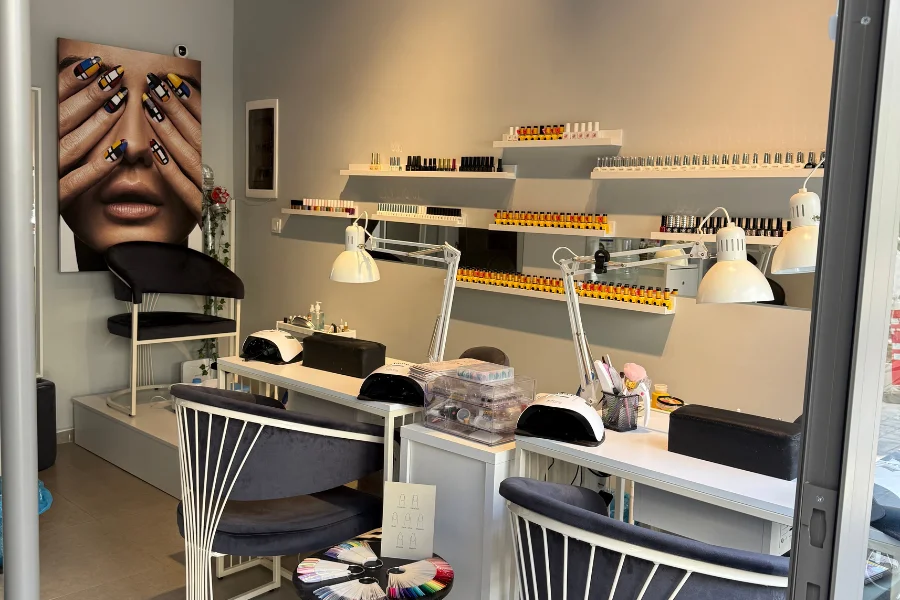
A practical layout should focus on how staff move and how services are delivered:
- Clear movement paths
Walkways should remain between 900 and 1200 mm to allow uninterrupted movement, especially during peak hours - Consistent workstation spacing
Each station should provide enough room for tools and technician movement without overlap or interference - Zoned service areas
Separating manicure and pedicure sections helps reduce cross-traffic and improves service flow
In multi-location or fast-scaling salons, operators often standardize layouts and equipment early to reduce setup variation. NovaBeauty is commonly involved in these types of projects, where consistent workstation configuration and coordinated equipment planning are required to support efficient daily operations.
The objective is not to add more equipment, but to ensure every element supports faster service and predictable workflow.
Why This Model Still Works Today
The rise of Vietnamese Americans in the nail industry demonstrates how a simple service can scale through the right structure.
Low entry barriers, internal training, and efficient operations created a system that is easy to repeat and adapt.
For salon owners, the takeaway is practical. Growth comes from building systems that improve daily efficiency and can be replicated across locations, rather than relying on complexity or one-time advantages.