
Start Here — Choosing the Right Nail Salon Type
The salon format should match your space, budget, and service positioning from the start. Changing direction later often leads to costly layout adjustments and underused equipment.
Use this quick decision guide:
- Limited budget with steady local demand
- Choose a traditional walk-in salon
- Premium positioning with high service value
- Choose a luxury or VIP nail spa
- Small space or solo operation
- Choose an independent studio
- Flexible location or low infrastructure commitment
- Choose a no-plumbing or mobile setup
This choice determines how your layout, equipment, and workflow will perform in daily operations.
The Most Common Nail Salon Types and How They Work
Traditional Walk-In Nail Salons
This format is designed for consistent volume and repeat customers.
- Typical space
- 500 to 1,000 sq ft
- 6 to 10 total stations depending on layout density
- Equipment setup
- 4 to 8 manicure tables
- 2 to 6 pedicure chairs with fixed plumbing
- Operational model
- Walk-in focused with fast turnover
- Layout priority
- Clear pathways and minimal idle space
This model works best in areas with stable foot traffic where efficiency and service speed drive revenue.
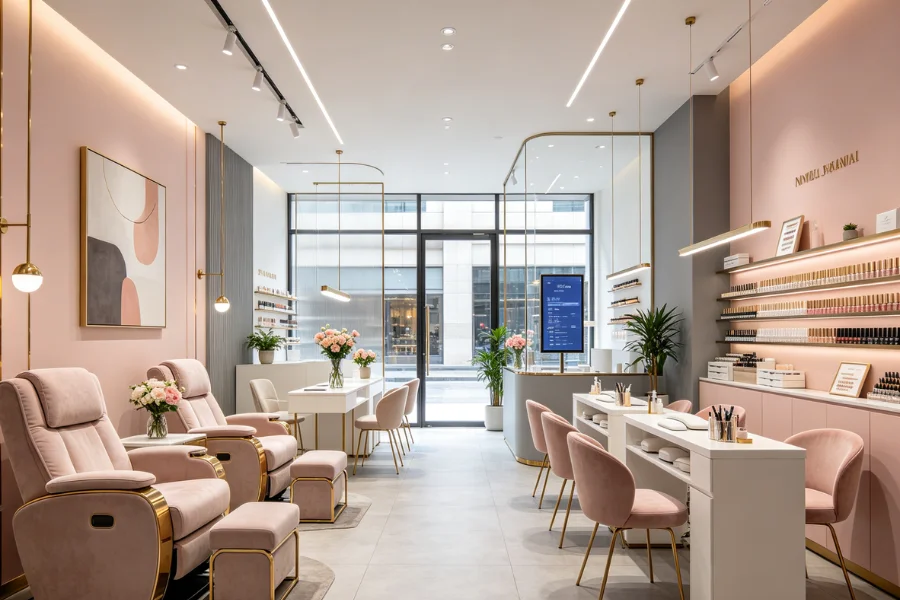
Luxury Nail Spas and VIP Salons
This format prioritizes service depth, privacy, and client experience.
- Typical space
- 1,000 to 2,500 sq ft
- Lower station density to maintain comfort
- Equipment setup
- Advanced pedicure chairs with massage and heating
- Private service rooms and lounge areas
- Operational model
- Appointment-based with longer service duration
- Layout priority
- Zoning for reception, treatment, and relaxation
This model performs best when the target client values time, privacy, and comfort over speed. Space planning must support separation and noise control.
Independent Nail Studios
This setup focuses on low overhead and full control of the service experience.
- Typical space
- 100 to 400 sq ft
- 1 to 3 total workstations
- Equipment setup
- 1 to 2 manicure tables
- Compact or optional pedicure solutions
- Operational model
- Appointment-only with high personalization
- Layout priority
- Maximum efficiency within limited space
This model is best suited for technicians building a personal brand or specializing in specific techniques.
In small spaces, plumbing installation often becomes a limiting factor. Many studios address this by using compact or no-plumbing pedicure solutions that reduce renovation requirements while maintaining service capability.
Mobile and No-Plumbing Nail Setups
This format is designed for flexibility and location independence.
- Typical space
- Temporary booths, shared retail areas, or home-based setups
- Equipment setup
- Portable manicure stations
- Pedicure units with integrated clean and waste water tanks
- Operational model
- On-demand, event-based, or hybrid service
- Layout priority
- Fast setup and minimal infrastructure
This model works best for testing new markets or operating in locations where permanent installation is not practical.
Removing fixed plumbing requirements allows operators to set up in commercial spaces that would otherwise not support traditional salons.
How Your Salon Type Shapes Layout, Equipment, and Workflow
Salon type determines how efficiently your space can operate. Poor alignment between concept and layout often leads to staff congestion and longer service times.
Workstation Spacing
Proper spacing supports both movement and service quality.
- Manicure tables
- 4 to 5 feet apart
- Pedicure chairs
- At least 5 feet clearance behind the chair
- Recommended density
- 1 workstation per 50 to 80 sq ft depending on service type
Tighter layouts increase capacity but reduce comfort and efficiency during peak hours.
Plumbing Requirements
Infrastructure decisions directly affect flexibility and cost.
- Traditional salons
- Require fixed water supply and drainage
- Studios and flexible setups
- Often use pedicure systems with internal water tanks
Reducing reliance on plumbing allows faster setup and easier relocation. This is especially relevant for leased spaces or multi-use environments.
Workflow and Movement
Each salon type requires a different movement pattern.
- Walk-in salons
- Continuous flow with minimal transition time
- VIP salons
- Segmented zones to separate service stages
- Studios
- Tools and materials positioned within arm’s reach
Efficient workflows reduce service time, improve consistency, and lower staff fatigue.
Equipment Strategy
Equipment selection should follow operational needs rather than visual preference.
- High-volume salons
- Prioritize durability and easy cleaning
- Premium salons
- Focus on ergonomics and comfort features
- Small studios
- Use compact, multi-functional furniture
- Flexible setups
- Choose modular and portable equipment
In practice, many salon owners rely on manufacturers that provide configurable equipment systems to match space constraints and service models. This approach reduces the need for major adjustments as the business evolves.
Common Mistakes That Lead to Inefficient Nail Salon Setups
Most inefficiencies come from decisions made without considering daily operations.
- Choosing a premium concept without enough space
- Reduces privacy and weakens the client experience
- Installing fixed plumbing in short-term or flexible spaces
- Limits future layout changes
- Over-investing in equipment before demand is stable
- Reduces financial flexibility without improving efficiency
- Ignoring workflow during layout planning
- Creates bottlenecks and longer service times
Each decision should support long-term usability rather than short-term appearance.
Quick Comparison — Which Nail Salon Type Fits Your Plan
| Factor | Walk-In Salon | VIP Salon | Independent Studio | Mobile / No-Plumbing |
|---|---|---|---|---|
| Budget | Low to medium | High | Medium | Medium |
| Space required | 500–1,000 sq ft | 1,000–2,500 sq ft | 100–400 sq ft | Flexible |
| Stations per setup | 6–10 | 4–8 | 1–3 | 1–4 |
| Equipment complexity | Moderate | High | Low to moderate | Low |
| Service style | Fast, standardized | Premium, extended | Personalized | Flexible |
| Setup flexibility | Low | Low | Medium | High |
This comparison helps align your concept with realistic space and operational requirements.
Practical Equipment Solutions for Different Nail Salon Types
Different salon models require different equipment strategies. The goal is to support workflow without adding unnecessary complexity.
- Walk-in salons
- Require durable manicure tables and high-efficiency pedicure chairs for continuous use
- VIP salons
- Benefit from ergonomic seating, integrated massage features, and customizable finishes
- Independent studios
- Need compact layouts and equipment that reduce installation constraints
- Mobile setups
- Depend on lightweight, modular systems for fast deployment
Manufacturers with OEM and ODM capabilities can adapt equipment to fit branding, layout constraints, and service positioning. NovaBeauty is one example of this approach, offering configurable solutions that support both small studios and larger salon environments.
Final Thoughts — Choosing a Salon Model That Works Long Term
Nail salons differ in format, but long-term performance depends on how well the concept aligns with space, workflow, and customer expectations.
Some clients prioritize speed and convenience, while others value privacy and experience. At the same time, salon owners must balance cost, efficiency, and flexibility.
Choosing the right salon type early provides a clear direction for layout planning, equipment selection, and daily operations. It reduces uncertainty and helps build a setup that performs consistently over time.