
I’ve seen a 300-square-foot salon that felt spacious and a 1,000-square-foot salon that felt cramped. The difference isn’t the size — it’s how you use the space. A small salon with smart station design can be more efficient and more profitable than a large one with wasted space.
Here are salon station ideas that actually work in tight spaces, based on real small-format salons I’ve visited.
Choose Space-Saving Equipment
| Equipment | Space-Saving Choice | Standard Choice |
|---|---|---|
| Styling Chair | Wall-mounted or foldable chair. Saves 2-3 sq ft per station when not in use. | Floor-standing with heavy base |
| Mirror / Station | Wall-mounted mirror with narrow shelf. No bulky cabinetry underneath. | Floor-standing station with drawers |
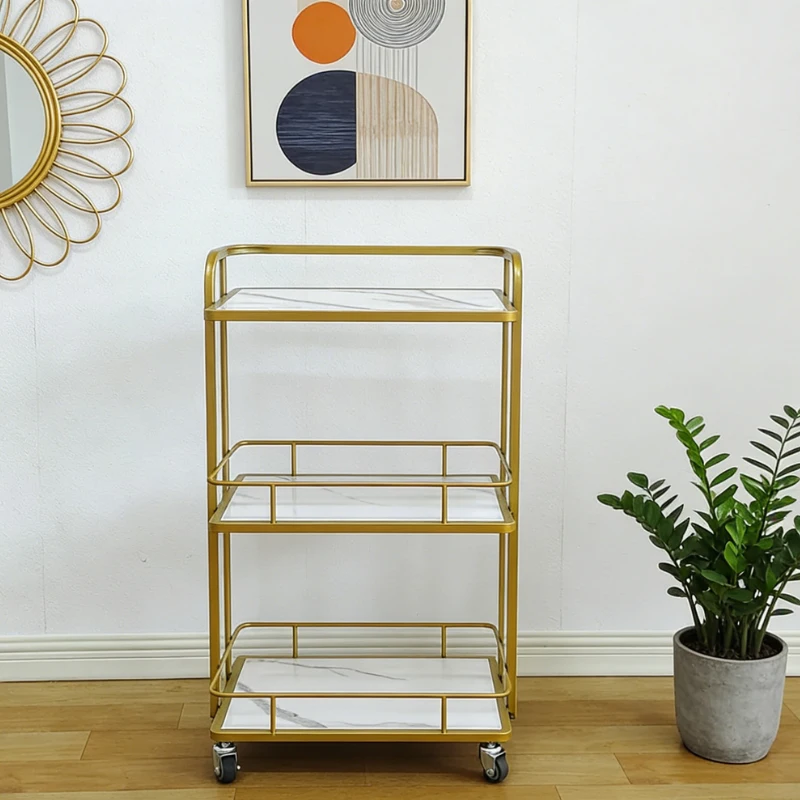
| Beauty Trolley | Narrow 3-shelf trolley (14-16″ wide). Rolls to the station, rolls away when not needed. | Fixed storage cabinet |
| Shampoo Station | Detachable lay-flat shampoo chair. Only bring out when washing. Folds against wall. | Fixed shampoo bowl and chair |
Layout Strategies for Small Salons
Side-by-side stations. Place styling chairs against one wall with mirrors above. This is the most space-efficient layout for cutting and styling. Chairs should be 4-5 feet apart minimum — any closer and stylists bump into each other.
Back-to-back islands. If you have 8+ feet of width, place two stations back-to-back with a shared mirror divider. This doubles your capacity in the same floor space. Used effectively in many European salons.
Multi-purpose stations. Treatment beds that convert to styling chairs. Wall beds that fold up when not in use. Tables on casters that move between roles. Every piece of furniture should earn its square footage.
Vertical Storage Saves Floor Space
In a small salon, wall space is prime real estate. Install floating shelves for retail products above the reception desk. Use pegboards with hooks for tools at each station. Magnetic strips hold metal tools (shears, clippers) without taking drawer space. Overhead cabinets above the shampoo station store bulk supplies.
The One-Trolley Rule
Each stylist should have one beauty trolley that holds everything they need for a full service. Everything on the trolley has a place. No walking to a central cabinet mid-service. In a small salon, the difference between an efficient station and a chaotic one is how many steps the stylist takes per client.
Reception Area in Small Spaces
In a salon under 500 sq ft, the reception desk should be a narrow counter (24″ deep max) with a small POS system. Don’t waste space on a large waiting area — use a bench along a wall with hooks above for coats. A small reception desk with wall-mounted display shelves keeps the front area functional without eating into treatment space.
Small Salon Equipment Priorities
- Styling chairs — Invest in quality. They’re the most-used piece and a cheap chair takes up the same space as a good one.
- Mirrors with good lighting — Wall-mounted, with integrated LED. Eliminates the need for separate task lighting.
- Trolleys not cabinets — Mobile storage is better than fixed in a small space.
- Wall-mounted drying stations — If you need hooded dryers, mount them on swing arms that tuck against the wall when not in use.
Final Take
A small salon can be more profitable per square foot than a large one — if you design the space intentionally. Choose wall-mounted equipment, use vertical storage, keep each station self-contained with a trolley, and don’t waste space on oversized reception or waiting areas. Every inch should earn its rent.
Browse our salon chairs and compact equipment for small-space studios.