
If you’re a nail tech, your desk is where you spend every working hour. The right setup means you can work longer without pain, keep your supplies organized, and give your clients a comfortable experience. The wrong setup means clutter, back pain, and clients waiting while you search for a file.
I’ve spent time with nail techs who work out of train cases and techs who run full multi-station studios. The desk is the one thing everyone agrees on: it matters more than the chair.
Types of Nail Desks & Manicure Tables
| Type | Who It’s For | Price (2026) |
|---|---|---|
| Nail Desk Table | Stationary salons. A dedicated table with storage, often with ergonomic cutouts for arm positioning. Laminate tops resist acetone. | $300 – $1,200 |
| Nail Desk with Dust Collector | Anyone who does acrylics or hard gel. Built-in dust extraction at the workspace — captures filings before they hit the air. Worth every penny for your lungs. | $600 – $2,000 |
| Portable Nail Desk | Mobile techs, event work, home visits. Folds up or converts from a carry case. Light enough to carry but sturdy enough for a full set. | $200 – $600 |
| Compact Nail Tech Desk | Small studio spaces, shared rooms. Fits in a corner but still has drawers for the essentials. | $200 – $800 |
| Manicure Table + Chair Set | New salon owners starting from scratch. Matched furniture — one less thing to coordinate. | $500 – $1,800 |
Dust Collection — Don’t Skip This
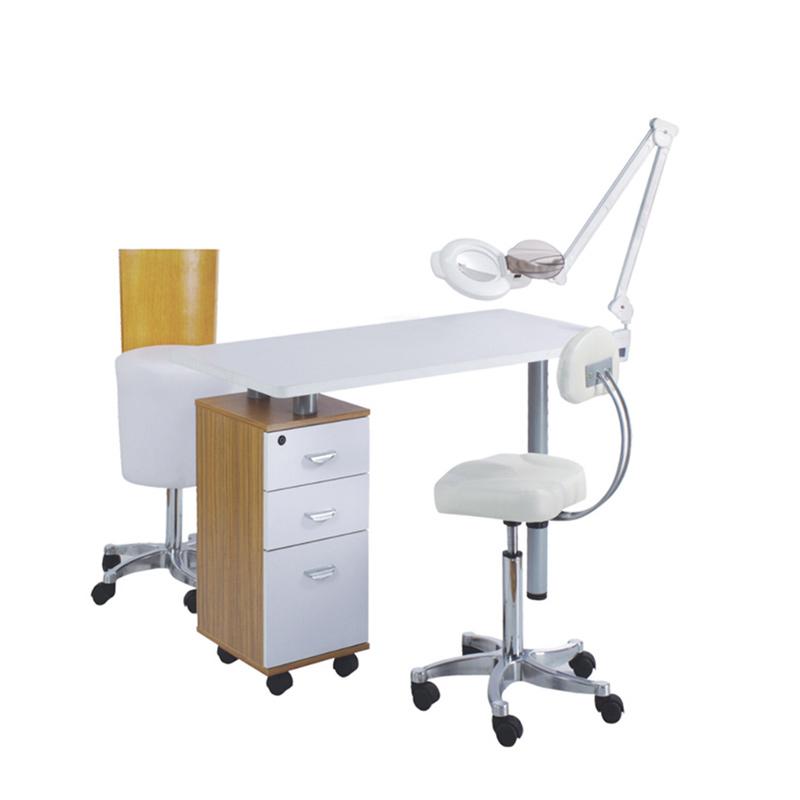
This is the one feature I’d tell every nail tech to prioritize: a nail desk with dust collector. Acrylic dust is invisible while you’re working, but it settles everywhere — in your lungs, on your clothes, in your client’s hair. A good dust collector captures 90%+ of filings at the source. See our white nail desk for specs and pricing.
More salons are moving toward integrated dust collection rather than standalone units. The integrated systems have the collector mounted under the desk with a vent at the work surface. They’re quieter, more effective, and take up less space. Look for HEPA filtration. Change the filters regularly — a clogged filter is worse than no filter because it recirculates dust.
Portable Nail Desks — The Mobile Tech’s Lifeline
Mobile nail techs have unique needs. You need a desk that’s light enough to carry, holds all your tools, and sets up quickly. The best portable nail desks convert from a rolling carry case into a full workstation. They have compartments for gels, polishes, files, lamps, and acetone. Everything has a home.
The most common complaint I hear about portable desks is that they’re too small for a full set-up. Look for one with a work surface at least 24″ wide and drawers that open fully. If the drawers are shallow, you’ll be stacking products on top of each other.
Lighting — The Overlooked Essential
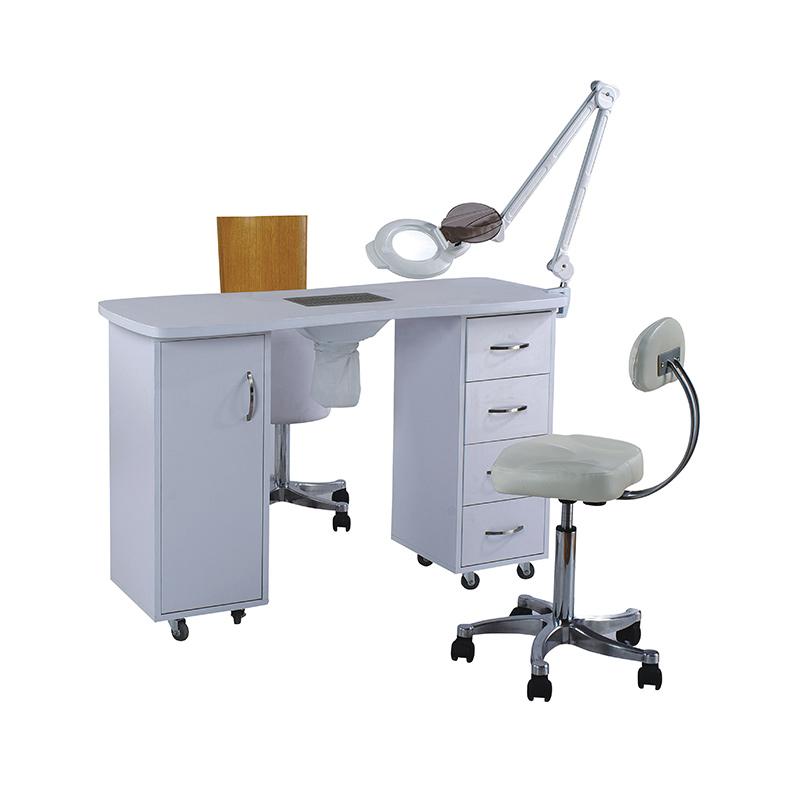
Good lighting at your nail desk isn’t optional. You need to see what you’re doing — cuticles, gel application, nail art details. A standard ceiling light isn’t enough because your hands cast shadows on your workspace.
Nail desk lamps come in a few types. Clip-on LEDs are affordable and flexible. Half-moon arc lights are popular among techs who do a lot of nail art — they provide shadow-free, 180-degree illumination. Look for lamps with adjustable brightness and color temperature (3000K-6000K). Warm light for relaxing services, cool light for precision work.
What to Look for When Buying
Surface material. Must be acetone-resistant. Laminate and engineered stone are the most common. Glass looks premium but shows every fingerprint and scratches easily. Wood needs to be sealed properly — acetone eats through unsealed wood.
Drawer space. You need more than you think. Gels, polishes, files, buffers, tips, glue, acetone, oils, brushes — it all adds up. Deep drawers with dividers are better than shallow ones.
Arm cutouts. Many nail desks have a curved cutout where your client places their arms. This lets you work closer to the client without reaching. If you’re tall or short, check the cutout depth.
Height. Standard desk height is 29-30 inches. If you’re particularly tall or short, consider an adjustable-height desk. Working at the wrong height for eight hours will cause shoulder and neck pain.
Real Prices (2026)
| Type | Factory Direct | US Distributor |
|---|---|---|
| Basic Nail Desk | $150 – $400 | $300 – $800 |
| Nail Desk with Drawers | $250 – $600 | $400 – $1,000 |
| Nail Desk + Dust Collector | $400 – $1,200 | $600 – $2,000 |
| Portable Nail Desk/Case | $100 – $300 | $200 – $600 |
| Complete Station (Desk + Chair) | $350 – $1,000 | $500 – $1,800 |
My Two Cents
Invest in a desk with dust collection and good storage. Portable if you travel, stationary if you have a fixed spot. And get a proper lamp — your eyes will thank you. Everything else is secondary.
Frequently Asked Questions
Nail desk vs manicure table difference?
Nail desks are larger with built-in storage and client-facing design. Manicure tables are compact workstation-focused.
How much does a professional manicure table cost?
Factory-direct: basic $150-$350, with dust collector $250-$550, granite top $400-$800. Save 40-55% vs retail.
Do I need a dust collector on my manicure table?
Highly recommended. Nail dust contains harmful particles. Built-in dust collectors improve air quality and health compliance.
What size fits a small salon?
Compact 36-40 inch tables fit small spaces. Standard 48 inch suits most. Corner L-shaped maximizes space.
Related Buying Guides
Complete your salon setup with these guides:
Check out our manicure tables for your nail studio.
Browse related: Pedicure Chairs | Beauty Trolleys.
Related Guides
- Read our Portable Salon Equipment Guide for more information.
Nail Table Supplier Price Guide (2026)
Factory-direct wholesale pricing for US salons depends on configuration, materials, and ventilation features. The following ranges reflect current 2026 pricing from established nail table suppliers who ship with a 110V US plug and DDP shipping. These are per-unit costs for single-piece orders (MOQ 1) and decrease with volume.
| Model/Type | Price Range (USD) | Best For |
|---|---|---|
| Basic Single-Station Manicure Table | $180 – $350 | New nail techs, mobile setups, or budget-conscious salons needing a durable work surface without ventilation. |
| Mid-Range Table with Built-In Dust Collector | $400 – $650 | Established nail techs performing acrylics or gels daily; requires strong suction for filing dust. |
| Premium LED Manicure Table with Nail Lamp | $700 – $1,000 | High-end salons offering luxury services; integrated LED lighting and curing lamps enhance client experience. |
| Double-Sided Pedicure & Manicure Combo Unit | $1,200 – $1,800 | Full-service spas needing a space-saving solution for multiple services in one station. |
| Portable Folding Nail Table | $120 – $220 | Home-based nail techs or professionals who travel to clients; lightweight and easy to store. |
| Customizable Multi-Station Island (4+ seats) | $3,500 – $6,000 | Large salons optimizing floor space; central island design allows four or more techs to work simultaneously. |
All units listed above are CE certified, wired for 110V US plug, and shipped via DDP (delivered duty paid) so you know the final landed cost upfront. As a wholesale nail table supplier, we keep MOQ at 1 to help you test a single unit before committing to a full salon order.
Nail Table Supplier Comparison & Buying Checklist
Before you finalize a purchase from any nail table supplier, run through this checklist. It covers the differences between budget and premium wholesale options and helps you avoid costly mistakes.
- Ventilation system type: Decide between a table with a built-in downdraft vent (pulls dust away from the client) versus a side-suction arm. Downdraft is quieter and more discreet, but side-suction arms are often more powerful for heavy acrylic work. Ensure the motor is rated for continuous commercial use.
- Power compatibility: Confirm the nail table supplier ships with a 110V US plug. Many overseas manufacturers default to 220V, which will not work in standard US salon outlets without a transformer. A legitimate wholesale supplier will configure the unit for US voltage before shipping.
- Certification and safety: Look for CE certification on the electrical components. This indicates the unit meets European safety standards for electromagnetic compatibility and low-voltage directives. Note that CE is not UL; if a supplier claims UL, verify the listing because most Chinese factories do not hold UL certification.
- Tabletop material and weight capacity: Choose between high-pressure laminate (HPL) or solid wood. HPL resists acetone and is lighter, while solid wood offers a premium feel but requires sealing. Check the weight rating—your table must hold a nail drill, lamp, and client’s arm without flexing.
- DDP shipping and final cost: Ask if the quoted price includes DDP shipping. If not, add 15-25% for freight, customs clearance, and brokerage fees. A transparent nail table supplier will quote a single all-in price, so you don’t get surprise charges at delivery.
- MOQ and warranty terms: A factory-direct wholesale supplier should offer MOQ 1 for initial testing. Also, confirm the warranty on the motor and electrical parts—standard is 12 months. Avoid suppliers who only offer a 90-day warranty on ventilation systems.
Frequently Asked Questions
What is the difference between a nail table and a manicure table?
The terms are used interchangeably in the US market. A nail table typically includes a built-in ventilation system for dust extraction, while a manicure table may be a simpler flat surface. For professional nail techs performing acrylics, choose a dedicated nail table with suction. Browse our nail table collection for ventilated options.
Can I order just one table from a wholesale nail table supplier?
Yes. Most factory-direct suppliers, including nova spa equipment, offer MOQ 1 for wholesale pricing. This allows you to evaluate build quality, ventilation noise, and finish before purchasing a full salon set. You still get the wholesale rate without committing to a container order.
Do I need a special electrical outlet for a nail table with a dust collector?
No. Our nail tables are wired for a standard 110V US plug and plug into any regular 15-amp wall outlet. The dust collector motor typically draws under 2 amps, so you can run a lamp and drill on the same circuit. Ensure the unit is CE certified for safe continuous operation.
What does DDP shipping mean for my salon order?
DDP means the supplier pays all shipping, customs duties, and taxes until the goods arrive at your salon door. You receive one final invoice with no hidden fees. This is standard for our factory-direct wholesale orders, making budgeting straightforward for US salon owners.
Nail Tech Tables: The Workhorse for Every Nail Professional
Whether you call it a nail tech table, a nail desk, or a manicure table, this is the surface a nail professional works on all day. A good nail tech table gives you a stable work area, storage for polish and tools, and enough depth for a client’s hands and forearms. Mobile nail technicians often prefer a lightweight nail tech table with wheels, while salon owners choose a fixed station with drawers and a dust collector port.
When choosing a nail tech table, consider height adjustability for your own posture, laminate or PU surface for easy cleaning, and whether you need a matching nail tech table stool. Nova manufactures nail desks and manicure tables in multiple sizes and finishes, and every order can be customized with drawer layouts, color, and logo branding. If you are outfitting a new nail studio, combine a nail tech table with a pedicure chair and reception desk from the same factory to keep the style consistent and simplify ordering.