
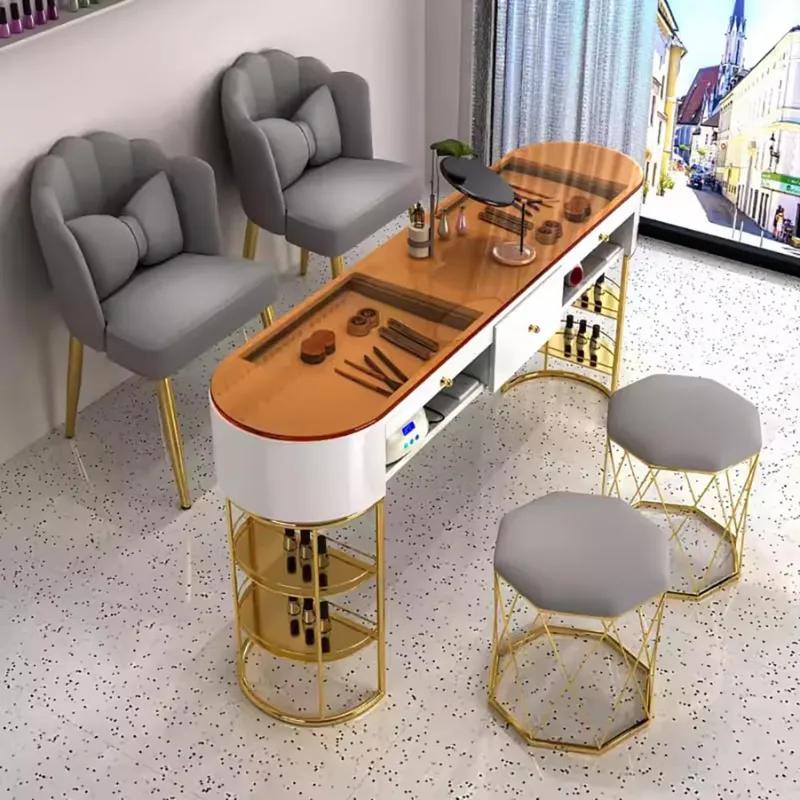
Why the Right Manicure Table Impacts Efficiency, Comfort, and Professionalism
A manicure table is not just a surface for nail services. It is a core workstation that directly affects technician performance, client comfort, and how professional your salon feels during daily operations.
When a table is poorly chosen, the impact shows quickly. Technicians compensate with posture, clients feel discomfort during longer services, and workflows become inefficient. Over time, these small issues turn into slower service, higher staff fatigue, and avoidable equipment replacements.
Choosing the right manicure table from the start helps stabilize operations, reduce long-term costs, and support consistent service quality.
Seven Practical Factors That Determine Whether a Manicure Table Is a Good Investment
How Table Materials Affect Durability, Maintenance, and Replacement Costs
Material choice determines how well a manicure table holds up against chemicals, daily wear, and frequent cleaning.
Stone countertops such as granite or quartz resist scratches, heat, and impact. Their non-porous structure stands up to acetone and disinfectants without staining. Salons that choose stone typically replace tables far less often. The tradeoff is higher upfront cost, but lower long-term replacement risk.
Glass tabletops support a clean, modern look and disinfect easily. The risk appears later. Fingerprints, smudges, and edge wear increase cleaning time, especially in high-volume salons. If glass is not properly finished, it can also become a safety concern.
High-pressure laminate and engineered wood offer strong chemical resistance and design flexibility. Quality laminates perform well in busy salons, while lower-grade options tend to swell or discolor over time. Choosing the right laminate matters more than the material category itself.
Powder-coated or stainless steel frames provide structural stability and resist corrosion. Weak frames often reveal themselves within the first year through wobbling or alignment issues.
If tables will be exposed to acetone and disinfectants daily, durability is not optional. Replacing underperforming tables after two years costs more than investing correctly once.
Choosing the Right Size and Shape for Your Salon Layout
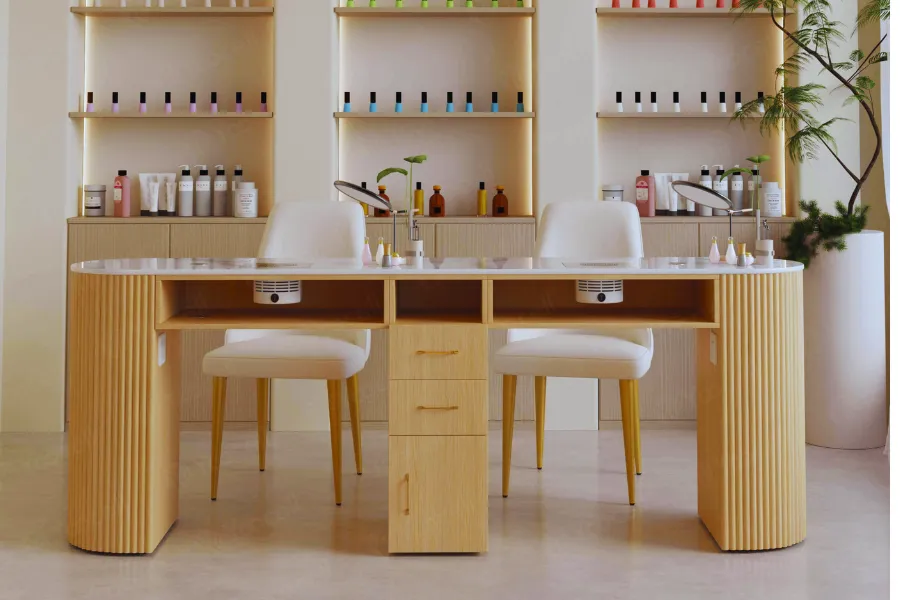
Proportions determine both comfort and efficiency.
A depth between 15 and 24 inches maintains a workable distance between technician and client. Tables that are too deep force technicians to lean forward, leading to shoulder and lower-back strain over time.
Width typically ranges from 40 to 60 inches and should be selected based on spacing between stations and foot traffic flow. Standard height falls between 30 and 32 inches and works best with adjustable stools.
Straight tables conserve space but limit ergonomic flexibility. Curved or T-shaped tables reduce forward reach and support longer service sessions. Double tables increase revenue per square foot but require careful spacing to avoid congestion.
If technicians frequently adjust their posture or reposition clients, the table size is likely wrong. This problem rarely resolves without replacement.
Features That Actually Improve Daily Workflow at the Manicure Station
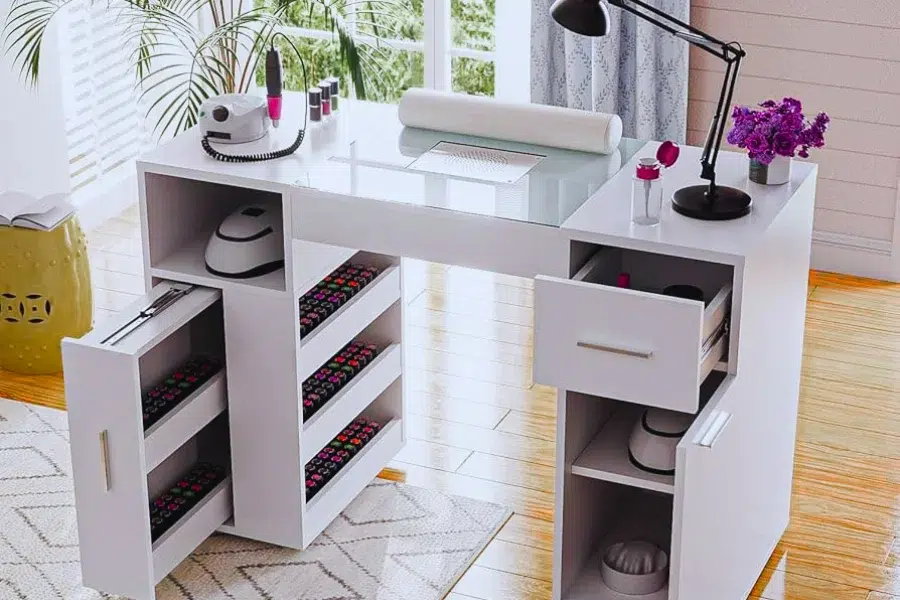
Not all features carry equal weight.
Built-in power outlets, adequate storage, and wrist support are non-negotiable for most salons. These features protect workflow consistency and reduce clutter.
Ventilation systems and UV lamp slots are strongly recommended for salons offering gel or acrylic services. They improve air quality, free tabletop space, and support cleaner service execution.
Mobility features and integrated trash compartments can be useful in specific layouts but should not be prioritized over structural stability or ergonomics.
When too many tools end up on the tabletop, service speed drops and sanitation becomes harder to maintain. Features that protect workflow should be prioritized over convenience add-ons.
Aligning Manicure Table Design With Your Salon’s Interior Style
Design should reinforce brand identity without compromising function.
Modern interiors benefit from glass, metal, and solid-color laminates. Industrial or vintage spaces pair well with wood and metal frames. Premium salons often use stone surfaces and subtle metallic accents. Spa-inspired environments lean toward lighter tones and curved profiles.
A visually cohesive space loses value if equipment underperforms or becomes difficult to maintain.
When to Choose a Mobile Manicure Table and When a Fixed Table Works Better
Mobile tables support flexible layouts and simplify cleaning, but only when equipped with reliable locking mechanisms. Fixed tables provide greater stability and suit salons with consistent layouts and high daily volume.
If technicians routinely brace the table while working, mobility is working against stability.
Balancing Budget and Long-Term Value When Buying a Manicure Table
Manicure tables typically range from $300 to $2,500 or more.
Lower-cost tables often show wear within two to three years. Higher-quality tables usually last significantly longer, reducing replacement frequency and operational disruption.
Evaluating value means looking beyond price. Warranty coverage, manufacturer experience, and service support matter. As a manufacturer specializing in commercial salon equipment, Nova regularly sees early replacements caused by material shortcuts rather than normal wear.
Why Ergonomics and Air Quality Matter for Long-Term Technician Health
Ergonomic alignment reduces fatigue and long-term injury risk.
Technicians should work with elbows close to a right angle, while clients’ wrists rest naturally on padded supports. Ventilation plays an equally important role. Fine dust and chemical vapors accumulate quickly during nail services, especially in high-volume salons.
Health-related upgrades are rarely reconsidered once problems surface. Prevention costs less than correction.
Common Types of Manicure Tables and Where Each One Makes Sense
Fixed tables offer stability and storage for permanent stations. Folding tables suit mobile services but sacrifice workspace. Height-adjustable tables improve ergonomics but add cost and complexity. Double tables increase efficiency in high-volume salons. Ventilated tables protect air quality and technician comfort.
Each type solves a specific operational problem. No single design fits every salon.
How to Maintain a Manicure Table for Long-Term Use
Clean surfaces with material-appropriate products and avoid prolonged moisture exposure on wood or laminate. Inspect hardware, casters, and outlets regularly. Maintain ventilation filters on schedule. Small maintenance gaps often lead to premature replacement.
Frequently Asked Questions
What features are essential in a manicure table?
A professional manicure table should include a durable, easy-to-clean surface, built-in storage, and accessible power outlets. Wrist support is important for client comfort and technician control. For salons offering gel or acrylic services, ventilation is strongly recommended to reduce dust and chemical exposure during daily operations.
How do I choose a table for a small salon?
For smaller salons, narrow-depth tables between 15 and 18 inches help preserve movement space. Mobile tables with lockable casters offer layout flexibility, while compact double stations can improve space efficiency when properly planned. The key is balancing footprint size with technician comfort and workflow needs.
Is stone or glass better for a manicure table?
Stone surfaces such as granite or quartz offer superior durability, chemical resistance, and long-term value. Glass provides a clean, modern look and is easy to disinfect but requires more frequent cleaning and careful edge finishing. The better option depends on service volume, maintenance expectations, and interior design priorities.
Is ventilation necessary for manicure tables?
Ventilation is highly recommended for salons that regularly use gel, acrylic, or chemical-based products. Built-in extraction systems help reduce airborne dust and fumes, improving air quality for both technicians and clients. Over time, proper ventilation supports a healthier work environment and reduces long-term comfort and safety concerns.
How should manicure table height be set?
Manicure table height should allow technicians to work with elbows close to a 90-degree angle while seated. Clients’ wrists should rest naturally on padded supports without lifting or strain. Proper height alignment helps reduce shoulder tension, wrist fatigue, and long-term ergonomic issues during extended service sessions.
What are the different types of manicure tables?
Common types include fixed tables for permanent stations, mobile tables with casters for flexible layouts, folding tables for limited spaces or mobile services, height-adjustable tables for ergonomic customization, and double tables designed to support multiple technicians in high-volume salons.
Is a manicure table a good investment for a salon?
A quality manicure table is a long-term operational investment rather than a simple furniture purchase. Well-built tables improve workflow efficiency, technician comfort, and client experience while reducing replacement frequency. Choosing durable materials and practical features typically results in lower overall costs and more stable salon operations over time.
Making the Right Manicure Table Decision for Long-Term Salon Success
A manicure table should be evaluated as a long-term operational asset, not a decorative purchase.
Before making a final decision, confirm that the materials can withstand daily chemical exposure, the size supports natural posture and efficient movement, and the features protect workflow and technician health over time.
Manufacturers with hands-on production and project experience, such as Nova, design equipment around these realities rather than short-term trends. A well-chosen manicure table reduces friction, supports healthier teams, and allows your salon to operate with confidence as demand grows.
Related Products for Your Salon Business
Browse our professional-grade salon equipment and furniture at factory-direct wholesale prices: